Alignment

How Shared Direction Is Built

Helping Regions Build A Shared View Of Future Workforce Demand

From Being Right to Getting It Right

Most leaders are rewarded for having answers. 

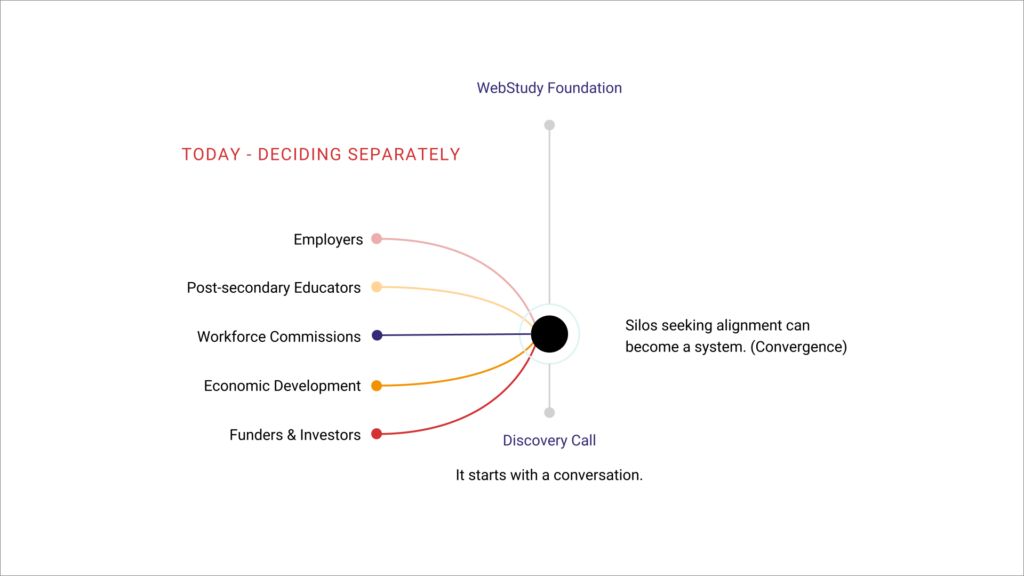
Employers understand hiring challenges. Educators understand learning pathways. Workforce leaders understand labor market dynamics. Economic developers understand regional growth

Each perspective is valuable. None is complete.

Systemic challenges require something different than organizational change. Participants must temporarily suspend the habits that make them effective inside their own institutions: defending expertise, advocating solutions too early, protecting organizational interests, and interpreting new information through existing assumptions. 

Not because those habits are wrong. Because they are often insufficient for seeing the larger system. 

The goal is not to determine who is right. 

The goal is to discover what the system is trying to tell us. 

That shift—from being right to getting it right—is where collective intelligence begins. 

This is the foundation of CapacityWorks™.

What Becomes Possible

  • A shared picture of future workforce demand
  • Aligned priorities that lay the groundwork for scaling what works
  • Greater clarity about each stakeholder’s role in the regional system
  • Decisions informed by employer demand
  • Stakeholder-owned direction and next steps
  • A shared understanding of the regional picture that increases everyone’s capacity to adapt

How CapacityWorks™ Turns Individual Perspectives Into Collective Intelligence

CapacityWorks helps diverse stakeholders build a shared view of the future workforce demand and the collective intelligence needed to act on it.

Unlike traditional convenings where participants primarily receive information, CapacityWorks™ engages stakeholders in a structured process that helps them think together, build meaning together, and identify what no single organization can see alone. 

The Process

Collaboration Arts combines structured dialogue and process architecture to help diverse stakeholders move from fragmented perspectives to shared direction, stakeholder ownership and coordinated action

System Snapshot

Reveal what silos hide.  Assess before you align.  You can’t align what you haven’t studied.

The System Snapshot™ combines key informant interviews, stakeholder mapping, and participant surveys to understand the regional workforce landscape before facilitation begins in the Regional Alignment Series.

Purpose:

  • Summarize the regional context
  • Identify the stakeholder landscape
  • Determine the fault lines between sectors
  • Assess readiness to collaborate

Outcome:

Shared picture of the regional workforce system and the factors shaping future work demand.

Bonus:

Determine where fragmentation is deepest, where readiness to collaborate is strongest and where trust across sectors still needs to be built.

Regional Alignment Launch Series™

Using the intelligence gathered through the System Snapshot™, Collaboration Arts designs three virtual working sessions that help stakeholders move from understanding to prioritization to coordinated action. 

SESSION ONE: See The System

The first session is not an assessment report handed down by consultants. It is a shared picture of the workforce challenge as stakeholders across sectors actually experience it. 

Where Are We?

See the Future Together

Output: A shared map of the workforce challenge as this region’s stakeholders actually experience it, with key themes identified for deeper exploration.

Purpose:

  • Create awareness of the stakeholders in the room
  • Present the workforce challenge from multiple perspectives
  • Highlight each stakeholder’s role in the larger system
  • Surface blind spots and opportunities
  • Identify areas of agreed importance for deeper exploration

Outcome:

A stakeholder-built understanding of the workforce challenge, the areas of agreed importance across sectors, and a shared foundation for prioritization and coordinated action.

Bonus:

The result is not a consultant report. It is a stakeholder-built understanding of the challenge.

SESSION TWO: Prioritize What Matters

The next session transforms understanding into shared priorities. 

Where Do We Agree?

Choose Together

Output: A ranked set of alignment priorities reflecting genuine cross-sector agreement — the foundation for a regional action agenda.

Purpose:

  • Validate and refine Session One findings
  • Identify the most urgent and actionable alignment opportunities
  • Prioritize where coordinated action will have the greatest impact
  • Capture cross-sector agreements and areas of convergence

Outcome:

A stakeholder-validated view of the regional workforce challenge and a prioritized set of alignment opportunities that establish where coordinated action should begin.

Bonus:

The expertise in the room becomes visible. Relationships emerge with the people who will ultimately carry the work forward.

SESSION THREE: Build the Mandate

Our last session converts shared priorities into ownership, commitments, and an ongoing coordination structure. 

What's the Path Forward?

Build to Scale

Output: A stakeholder-owned design brief for next-phase coordination – clear priorities, identified leadership, and individual sector commitments.

Purpose:

  • Translate agreed priorities into coordinated action 
  • Clarify how stakeholder roles fit together moving forward
  • Identify who else needs to be engaged
  • Define the structure for ongoing coordination
  • Translate shared priorities into sector-level commitments and first steps
  • Establish a stakeholder-owned statement of regional direction

Outcome:

A stakeholder-owned mandate that transforms shared priorities into sector-level commitments, coordinated leadership, and a sustainable structure for regional action. 

Bonus:

Regional direction cannot be imposed. It must be built through dialogue that helps stakeholders understand one another’s realities, identify shared priorities, and create direction they trust enough to act on together.

Question Sequencing

Participants are guided through carefully constructed questions that move a group from individual perspective to shared understanding – without leading them to a predetermined answer.

Structured Small Group Dialogue

Breakout conversations ensure every voice is heard – not just the loudest ones in the room. Small groups surface perspectives that never emerge in large plenary settings.

Collaborative Engagement Technology

Real-time technology captures input from every participant simultaneously – making the collective picture visible to everyone as it forms. No waiting for a report. No personal or institutional filter/bias applied to what people said and what gets recorded.

Theme Team Synthesis

A skilled theme team listens across breakout groups and synthesizes diverse input into shared patterns in real time – so participants see their own ideas taking shape before the session ends.

The result is not a summary written afterward. It is a living record built during the engagement – owned by the people who created it.

What a SyncForward™ Engagement Produces

  • What most convenings never do
  • Engagement deep enough to shift perspective, not just inform it
  • Dialogue that challenges participants to think more boldly
  • Cross-silo connections that no single organization could see from its own vantage point
  • Real-time visibility into collective thinking as it emerges

When people leave saying “We never could have accomplished that any other way” – that’s when alignment is real.

The Questions That Start the Conversation

Before a SyncForward™ engagement begins, every region should be able to answer these:

These are not rhetorical questions. They are the foundation every SyncForward™ engagement is built on – and the starting point for your System Snapshot.

Name(Required)

Name(Required)

Name(Required)